






By Ishat Jain, Founder, SUNROOOF
In hospitality, the experience of a space is shaped by more than its architecture or interiors. Materials, colour, furniture, acoustics and lighting work together to determine how a guest perceives and occupies an environment. Yet lighting is often treated as a technical layer added after the primary design decisions have been made.
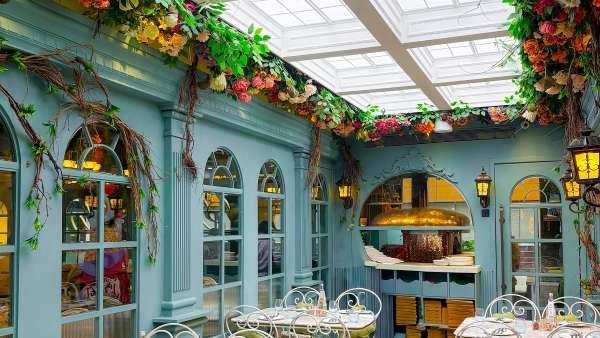
A more integrated approach can make light part of the architectural experience itself. Café de Flora, a 5,550 sq. ft. hospitality project at Ambience Mall, Vasant Kunj, demonstrates how this approach can address both the identity and performance of a hospitality space.
The café draws from a floral, French inspired visual language, expressed through turquoise walls, arched glass windows and botanical detailing. However, being located within a commercial environment, the space had limited access to natural daylight. This created an important design question: How can an enclosed hospitality environment retain a sense of openness and connection to the sky?

The answer lay in introducing a more considered approach to lighting.
Using Light to Shape the Space
At Café de Flora, SUNROOOF was integrated as a wellness lighting intervention, creating the perception of an opening towards the sky. Rather than functioning as a conventional light source, it became part of the spatial composition, working alongside the arches, colours and floral elements.
The intention was not to replicate sunlight literally, but to introduce some of the qualities associated with daylight, including softness, openness and variation, into an environment where natural light was limited.
This distinction is important. The value of wellness lighting lies not simply in how it illuminates a space, but in how it can influence the way that space is perceived and experienced.
The lighting environment can also evolve through the day. This is particularly relevant to hospitality, where the same restaurant may function as a bright daytime café, a meeting space in the afternoon and a more intimate dining environment in the evening. Instead of maintaining one fixed lighting condition, wellness lighting can become part of this transition.
From Fixture to Methodology
The larger lesson from the project is that lighting should enter the design process much earlier. Rather than beginning with “Where should the fixtures be placed?”, designers can begin with “What should the guest experience?”
This can then inform decisions around the placement of light, materials, reflectance, sightlines, seating and the duration for which the space is occupied.
At Café de Flora, the lighting intervention works because it responds to a specific spatial challenge while reinforcing the overall design concept. It contributes to the perceived openness of the space, creates a stronger sense of connection to the outdoors and helps establish different atmospheres across the day.
This becomes particularly relevant in contemporary hospitality interiors, where access to natural daylight is often limited. Restaurants, cafés and hotels are increasingly being designed within malls, commercial developments and deep plan spaces. Here, wellness lighting can move beyond its functional role to shape atmosphere, influence spatial perception and contribute to the overall comfort of the guest experience.
The future of hospitality lighting may therefore lie less in adding more fixtures and more in designing environments that respond to how people experience a space throughout the day.
Café de Flora demonstrates how this can be achieved by treating light as more than illumination and wellness lighting as part of the overall spatial experience. When light becomes part of the architecture, it can shape how a hospitality space feels, functions and is remembered.
About Author: Ishat Jain is the Founder of SUNROOOF, a pioneering technology and design company redefining indoor lighting by recreating the experience of natural sunlight indoors. A school dropout at 14 and entrepreneur by 16, Ishat combines unconventional learning with innovation-driven thinking. After spending more than four years in R&D and developing over 100 prototypes, he built SUNROOOF into a ₹50 crore business with over 1,800 installations across India and the UAE, serving leading brands, businesses and homeowners.
Get real time update about this post category directly on your device, subscribe now.